Taking the first step toward therapy can feel overwhelming, especially when you don’t know what to expect. You might wonder what your therapist will ask, how much you’ll need to share, or whether you’ll know what to say when the session begins. If you’re seeking help with intense emotions, difficult relationships, or patterns you want to change, it’s natural to have questions before your first appointment.
Dialectical Behavior Therapy (DBT) offers a structured, skills-based approach to understanding emotions and responding to life’s challenges more effectively. Your first session is an opportunity to discuss your concerns, explore your goals, and begin understanding how treatment works.
In this guide, we’ll walk you through what happens during your first DBT session, how to prepare, and what to expect as treatment continues.
What Is DBT Therapy, and How Does It Work?
Dialectical Behavior Therapy (DBT) is a type of therapy that helps people manage intense emotions, cope with distress, and build healthier relationships. It combines two important ideas: accepting yourself and your experiences as they are while also working toward meaningful changes in your thoughts, feelings, and behaviors.
DBT focuses on developing practical skills you can use in everyday life, particularly when emotions feel difficult to manage or situations become overwhelming. These skills fall into four main areas:
- Mindfulness: Learning to stay present and notice your thoughts and feelings without immediately reacting to them.
- Distress tolerance: Finding ways to get through difficult moments without making the situation worse.
- Emotion regulation: Understanding your emotions and developing healthier ways to respond to them.
- Interpersonal effectiveness: Communicating your needs, setting boundaries, and navigating relationships more effectively.
Unlike approaches that may focus primarily on exploring your experiences, DBT also emphasizes practicing new skills and applying them outside therapy. Your therapist works with you to understand your challenges, identify goals, and determine how these skills can support your needs. The process is collaborative, and the skills you work on will depend on your circumstances and treatment goals.
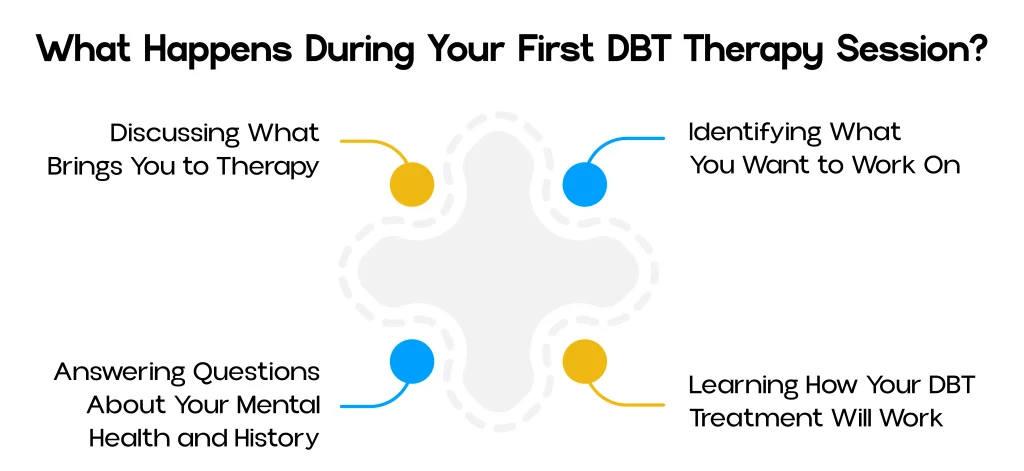
What Happens During Your First DBT Therapy Session?
Your first DBT therapy session will likely involve getting to know your therapist, discussing what brings you to treatment, and deciding what needs attention first. The exact process depends on your therapist, your circumstances, and whether the appointment is an initial intake or the beginning of an established DBT program.
You may spend much of the session answering questions and explaining what’s been happening in your life. You might not begin practicing DBT skills right away, and that’s normal. The first appointment often helps your therapist understand your needs before deciding how to approach treatment.
Discussing What Brings You to Therapy
Your therapist will likely ask what prompted you to seek help at this point in your life. Perhaps you’re struggling with intense emotions, experiencing repeated conflict in your relationships, reacting in ways you later regret, or finding it difficult to cope when things don’t go as planned.
You may be asked to describe specific situations rather than talk about your experiences in general. For example, your therapist might ask what happens when you feel rejected, what you do when an argument becomes overwhelming, or how you respond when you’re under stress.
You don’t need to explain everything perfectly. If you’re unsure where to start, you can describe the problem that has been bothering you most recently.
Answering Questions About Your Mental Health and History
An initial appointment may include questions about your mental health history, previous therapy, current symptoms, relationships, and how your difficulties affect everyday life. Your therapist may also ask about medication, other treatment providers, and the coping strategies you’ve tried.
Depending on your circumstances, they may ask about sleep, work or school, family relationships, substance use, or experiences that contribute to your current difficulties. They may also ask direct questions about safety, including thoughts of self-harm or suicide, when clinically relevant.
You might not cover every topic in one appointment. Some therapists use intake questionnaires or assessment forms, while others gather information through conversation. If you have completed paperwork before arriving, your therapist may use that information to guide the discussion.
Identifying What You Want to Work On
Your therapist may ask what you would like to be different in your life. You might want to handle emotional situations without acting impulsively, communicate more effectively, reduce behaviors that create problems, or manage distress without making an already difficult situation worse.
In DBT, treatment goals are often made concrete. Instead of simply wanting to feel better, you might work toward recognizing emotional triggers earlier, responding differently during arguments, or using coping skills before a situation escalates.
You don’t have to know your goals in advance. Your therapist can help you identify priorities, and some goals may become clearer after you’ve had time to explore your experiences.
Learning How Your DBT Treatment Will Work
If you’re entering a comprehensive DBT program, your therapist may explain the different parts of treatment and what participation involves. These may include individual therapy, group skills training, phone coaching, and a therapist consultation team.
Your DBT therapist may also explain how sessions are structured, how progress is reviewed, and what role practicing skills between appointments plays in treatment. Depending on the program, you may discuss treatment agreements, attendance expectations, or how to access support between sessions.
Not every provider offers the same DBT structure, so it’s worth asking which components are included in your particular program.
By the end of the appointment, you may have a clearer idea of the next steps, although a complete treatment plan may take more than one session to develop. It’s also fine to leave with unanswered questions. The initial appointment is the beginning of the process, not a test you need to pass.
Will You Learn DBT Skills in Your First Session?
You might expect to start learning techniques as soon as you begin DBT therapy, but your first appointment may focus more on understanding your concerns and discussing how treatment works. Whether you practice a skill during that session depends on your therapist’s approach, your immediate needs, and where you are in the treatment process.
If your therapist introduces a DBT skill, it may relate to something you’re currently experiencing. For example, if you tend to react quickly when emotions run high, you might begin exploring how to pause and notice what’s happening before responding. If stressful situations feel difficult to tolerate, your therapist may discuss ways to get through those moments without making things worse.
Over time, DBT treatment involves learning and practicing skills in four main areas: mindfulness, distress tolerance, emotion regulation, and interpersonal effectiveness. You may work on these skills during individual therapy, structured skills training, and practice between sessions, depending on your program.
The goal isn’t to master every skill immediately. Learning takes practice, and you may need time to understand which strategies work best for you. Your therapist can help you apply these skills to real situations and work through the difficulties that arise along the way.
How to Prepare for Your First DBT Session
You don’t need to do extensive preparation before your first DBT session. However, spending a few minutes thinking about what you want help with can make it easier to explain your concerns and get the conversation started.
- Think about what’s been difficult lately. Consider situations that leave you feeling overwhelmed, patterns in your relationships, or moments when you struggle to manage your emotions. You don’t need to identify every issue; one or two examples are enough to start.
- Consider what you want help with. You might want to handle conflict differently, cope with distress more effectively, or understand your emotional reactions. It’s also fine if you’re not sure what your goals should be yet.
- Write down any questions. You may want to ask how DBT works, what treatment involves, or whether you’ll attend individual sessions, skills training, or both.
- Bring relevant information. If requested, complete intake paperwork and bring details about current medications, previous treatment, or other information your therapist needs to understand your situation.
- Give yourself permission to feel nervous. You might find it difficult to talk openly with someone you’ve just met. You can tell your therapist that you’re feeling anxious or unsure where to begin.
The most important thing to remember is that you don’t need to arrive with everything figured out. Your therapist can help you work through your concerns one step at a time.
What If You Feel Nervous or Don’t Know What to Say?
Meeting a new therapist and talking about personal experiences can feel uncomfortable, especially if you’re not used to opening up about your emotions. You might worry about being misunderstood, struggle to find the right words, or feel unsure about where to begin. These feelings don’t mean you’re doing anything wrong.
The purpose of therapy is to help you better understand what you’re experiencing and find ways to work through your challenges. You shouldn’t feel that you have to explain everything perfectly or have all the answers before your first session. Your therapist is there to help guide the conversation, understand your concerns, and work with you to identify what might help.
You don’t have to share your entire story at once. You can start with what’s easiest to explain and take your time with more difficult subjects. If you feel confused, overwhelmed, or unsure about a question, let your therapist know. You can ask them to explain something differently or give you a moment to gather your thoughts.
For example, you might say, “I’m not sure where to start, but I know I’m struggling to manage my emotions.” That alone can be enough to begin a conversation.
Although therapy can sometimes bring up uncomfortable feelings, you should have the opportunity to ask questions and discuss how the process feels for you. Building trust takes time, and your first session is simply a starting point. You don’t need to figure everything out in one appointment.
What Happens After Your First DBT Session?
After your first DBT session, you may have a clearer understanding of what you’re experiencing and what you want to work on, although it’s also normal to still have questions. Your therapist may discuss the next steps, recommend further assessment, or begin developing a treatment plan with you. What happens next depends on your needs and how your treatment is structured.
In subsequent individual sessions, you may explore situations that trigger difficult emotions, identify patterns in your responses, and work on practical ways to handle challenges differently. If you’re participating in a comprehensive DBT program, you may also attend skills training sessions to learn techniques for managing emotions, tolerating distress, and communicating more effectively.
Practicing these skills outside therapy is an important part of DBT. Your therapist may encourage you to notice how you respond to challenging situations or try a particular skill between appointments. The goal is to gradually apply what you learn to everyday life, not to get everything right immediately.
Progress looks different for everyone. Some changes may become noticeable over time, while others require continued practice and support. If you’re unsure about your treatment plan or what to expect next, ask your therapist to walk you through it. Understanding the process can help you feel more prepared as you continue.
Take the First Step Toward DBT Therapy in Austin
Starting therapy doesn’t mean you need to have everything figured out. Your first DBT session is an opportunity to talk about what you’re experiencing, ask questions, and begin exploring ways to manage emotions and navigate life’s challenges more effectively. You can take the process one step at a time, with support along the way.
At Austin DBT Associates, we offer DBT counseling for adults and teens, along with structured skills training to help individuals develop practical tools for everyday life. If you’re considering DBT therapy in Austin, our team can help you explore your options and understand what getting started involves.
Call (512) 902-3282 or email intake@adbta.com to learn more about our services and take the next step toward building a life worth living.