Knowing that you need to “calm down” is one thing. Knowing how to calm yourself when emotions feel overwhelming is another. Strong emotions can affect how you think, communicate, make decisions, and respond to the people around you. In those moments, it can be difficult to pause and choose a response that reflects what you actually want.
Dialectical Behavior Therapy (DBT) offers practical skills for navigating these moments. It helps you recognize and regulate emotions, tolerate distress without making a difficult situation worse, communicate more effectively, and build healthier relationships.
These skills are not about eliminating difficult emotions or forcing yourself to “think positive.” Instead, they teach you how to notice what is happening, understand your emotional response, and choose what to do next. In this guide, we’ll explore some of the most useful DBT skills for emotional regulation, relationships, and everyday situations, along with how you can apply them when you need them most.
What Are DBT Skills?
Dialectical Behavior Therapy (DBT) is a structured form of therapy. It helps people develop healthier ways to manage emotions, cope with distress, communicate with others, and respond to difficult situations. A central part of DBT is learning practical skills that can be used in everyday life, especially during moments when emotions feel intense or difficult to manage.
DBT skills are organized into four main areas, and each one addresses a different part of emotional and behavioral health.
- Mindfulness helps you stay aware of what is happening in the present moment without immediately judging or reacting to it.
- Distress tolerance teaches strategies for getting through painful or overwhelming situations without making them worse.
- Emotion regulation helps you understand your emotions, reduce emotional vulnerability, and respond to feelings in healthier ways.
- Interpersonal effectiveness focuses on communicating clearly, setting boundaries, managing conflict, and maintaining healthy relationships.
DBT Skills for Emotional Regulation
Emotions are a normal part of being human, but they can become difficult to manage when they feel unusually intense, last longer than expected, or lead to reactions that create problems in your life. DBT does not teach you to eliminate difficult emotions. Instead, emotion regulation skills help you understand what you are feeling, identify what is influencing it, and respond in more helpful ways.
Identify and Name the Emotion
One of the first steps in regulating an emotion is recognizing what you are actually feeling.
Ask yourself:
- What happened?
- What emotion am I experiencing?
- How intense is it?
- What thoughts are connected to this emotion?
For example, you might initially think, “I am just angry.” After slowing down, you may realize that the anger is connected to feeling rejected, embarrassed, disappointed, or afraid of losing someone important to you.
Check the Facts
Our emotional responses can sometimes be influenced by assumptions, interpretations, or incomplete information. The DBT skill known as Check the Facts involves looking at what actually happened and separating observable facts from the meaning you have assigned to them.
For example, imagine that a friend does not respond to your message for several hours. You might immediately think, “They are upset with me” or “They do not want to talk to me anymore.” Those thoughts can trigger anxiety, anger, or sadness.
Checking the facts means asking:
What do I know for certain? What am I assuming? Are there other possible explanations?
Checking the facts does not mean telling yourself that your feelings are wrong. It means making sure your emotional response is based on the situation as it actually is rather than on an assumption that may not be accurate.
Practice Opposite Action
Emotions often come with strong urges. Anger may create an urge to argue. Fear may make you want to avoid something. Shame may make you want to withdraw from other people.
Opposite Action involves recognizing an emotional urge and, when appropriate, choosing a response that runs counter to it.
For example, if anxiety makes you want to avoid a situation that is uncomfortable but safe, gradually approaching the situation may be more helpful than continuing to avoid it. If anger creates an urge to attack someone verbally, choosing to step away, lower your voice, and communicate calmly may prevent the situation from escalating.
Opposite Action is not about ignoring emotions or forcing yourself to behave in a way that feels unnatural. It is about considering whether the emotional urge is helping you achieve what you actually want.
Reduce Emotional Vulnerability
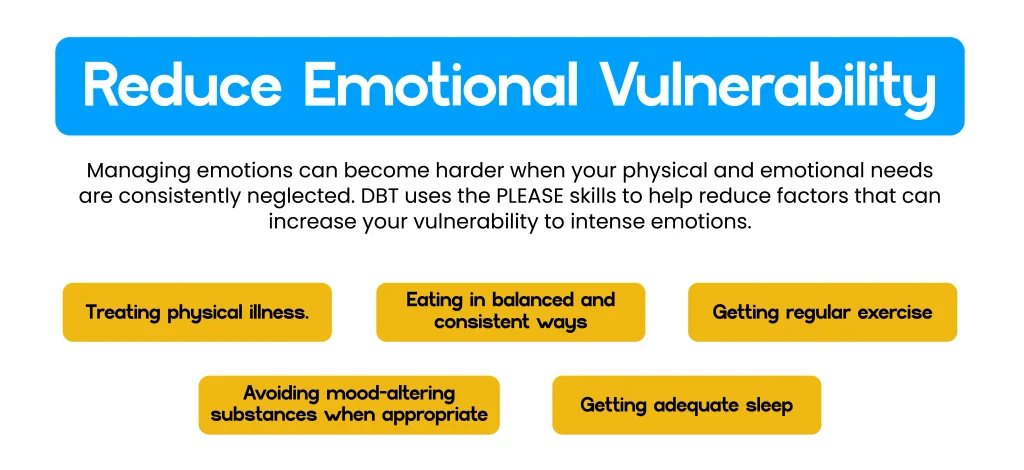
Managing emotions can become harder when your physical and emotional needs are consistently neglected. DBT uses the PLEASE skills to help reduce factors that can increase your vulnerability to intense emotions.
PLEASE refers to practices related to:
- Treating physical illness
- Eating in balanced and consistent ways
- Avoiding mood-altering substances when appropriate
- Getting adequate sleep
- Getting regular exercise
DBT Skills for Managing Intense Distress
Emotion regulation skills can help you manage emotional patterns over time, but sometimes emotions become too intense to analyze or solve the underlying problem immediately. In those moments, DBT distress tolerance skills can help you get through the situation without making it worse.
Distress tolerance is not about approving of a painful situation or pretending that everything is fine. It is about learning to tolerate a difficult moment long enough to respond thoughtfully rather than react impulsively.
Use the STOP Skill Before You React
The STOP skill can be useful when you feel an immediate urge to say or do something you may regret.
S: Stop. Do not act on the first impulse.
T: Take a step back. Create some physical or emotional distance from the situation if possible.
O: Observe. Notice what you are feeling, thinking, and wanting to do.
P: Proceed mindfully. Choose your next action based on what will actually help rather than what the emotion is urging you to do.
For example, if you receive an upsetting message, your first instinct might be to respond immediately. Using STOP gives you an opportunity to pause, recognize your anger, and decide whether responding now will help or worsen the situation.
Sometimes the immediate goal is simply to get through the next few minutes without making the situation worse. Once the emotional intensity decreases, you can return to the underlying problem and decide what needs to happen next. First survive the emotional moment, then solve the problem.
DBT Skills for Healthier Relationships
Relationships can become difficult when strong emotions, misunderstandings, or conflicting needs enter the picture. You may know that you want to communicate calmly, but in the moment, anger, fear, disappointment, or anxiety can make it difficult to express yourself clearly.
DBT interpersonal effectiveness skills provide practical tools for communicating what you need while also considering the relationship and your own self-respect.
Use DEAR MAN to Ask for What You Need
DEAR MAN is a DBT skill that can help you make a request, set a boundary, or address a problem in a clear and effective way.
The steps are:
- Describe: Explain what happened using specific, observable facts.
- Express: Explain how the situation affects you or how you feel.
- Assert: Clearly state what you want or need.
- Reinforce: Explain why the requested change could be helpful.
- Mindful: Stay focused on your main point instead of getting pulled into unrelated arguments.
- Appear confident: Communicate in a way that shows you take your needs seriously.
- Negotiate: Be willing to seek a solution that works for both parties when appropriate.
For example, instead of saying, “You never listen to me,” you might say:
“When I am talking about something important, and you start looking at your phone, I feel like I am not being heard. I would like us to put our phones away when we are having an important conversation.”
Use GIVE to Protect Your Relationships
Sometimes your goal is not simply to get what you want. You may also want to maintain trust, connection, and respect within the relationship. GIVE can help you communicate in a way that supports the relationship while discussing difficult issues.
GIVE stands for:
- Gentle: Avoid unnecessary attacks, threats, or judgment.
- Interested: Listen to the other person’s perspective and show that you are paying attention.
- Validate: Acknowledge the other person’s feelings or point of view, even when you disagree.
- Easy manner: When appropriate, use a calm and approachable communication style rather than escalating the interaction.
Validation does not mean agreeing with everything someone says. You can recognize that another person has a reason for feeling the way they do while still expressing a different opinion or maintaining a boundary.
Use FAST to Maintain Self-Respect
There are situations where getting your request accepted is not the most important goal. You may instead need to make a decision that allows you to remain honest and act in line with your values. This is where FAST can be useful.
FAST stands for:
- Fair: Consider your own needs as well as the other person’s.
- Apologies: Avoid unnecessary apologies for expressing yourself appropriately or for having reasonable needs.
- Stick to your values: Stay connected to what matters to you rather than abandoning them simply to avoid conflict.
- Truthful: Be honest and avoid exaggerating, manipulating, or making false promises.
DEAR MAN helps you communicate what you want, GIVE helps protect the relationship, and FAST helps maintain self-respect. In some situations, you may use all three together.
How to Practice DBT Skills So They Become Easier to Use
DBT skills become easier to use with practice. If you only try to remember them when you are overwhelmed, it can be difficult to know which skill to use. Practicing when your emotions are manageable gives you an opportunity to become familiar with the skills before you need them most.
You do not need to practice every DBT skill at once. Start with one or two that match situations you experience regularly. You can also keep track of situations that trigger strong emotions and note which skills you tried and what happened afterward.
A simple way to build the habit is:
Notice > Choose > Practice > Reflect
Notice: Identify what you are feeling and what is happening.
Choose: Select a skill that fits the situation.
Practice: Use the skill rather than relying on your usual automatic response.
Reflect: Consider what helped, what did not, and what you might try differently next time.
If you are having difficulty applying DBT skills or managing intense emotions on your own, a trained DBT therapist can provide guidance and help you practice these skills in the context of your specific needs.
When DBT Therapy May Be Helpful
Learning DBT skills can give you practical tools for managing emotions, coping with distress, and navigating relationships. However, it can be difficult to know which skills to use or how to apply them when emotional patterns are deeply established or significantly affecting your daily life.
Working with a trained DBT therapist can provide personalized guidance, structured practice, and support as you learn to apply these skills to situations you are actually experiencing. Therapy can also help you understand the patterns behind your emotions and behaviors rather than simply managing difficult moments as they arise.
If intense emotions, relationship difficulties, impulsive reactions, or ongoing distress are making it harder to function or enjoy your everyday life, DBT may be worth exploring. You do not have to wait until things feel unmanageable to seek support.
Final Thoughts
DBT skills are not about never feeling angry, anxious, overwhelmed, or hurt. They are about developing the ability to recognize your feelings, tolerate difficult moments, communicate more effectively, and make choices that support the life and relationships you want.
With practice, these skills can become easier to access in everyday situations. You may not always respond perfectly, and you do not need to. The goal is to create more space between what you feel and how you respond, giving you greater flexibility and control when emotions become difficult to manage.